
Pole Bending Clinics with Ken Smith
NOTE: As of 2025, I do not plan to leave home for any more clinics. I am still giving lessons locally, and local clinics are still possible.
Why is it that pole bending is such a challenging event for riders and horses to learn? As with every equine activity, it's all about horsemanship! Pole bending is by far the most complex and challenging of the speed events, with ten lead changes and three turns, each separated by only a heartbeat of time. We call it precision dressage at speed. It's a high speed dance, with the rider leading, but so together that they appear as one.
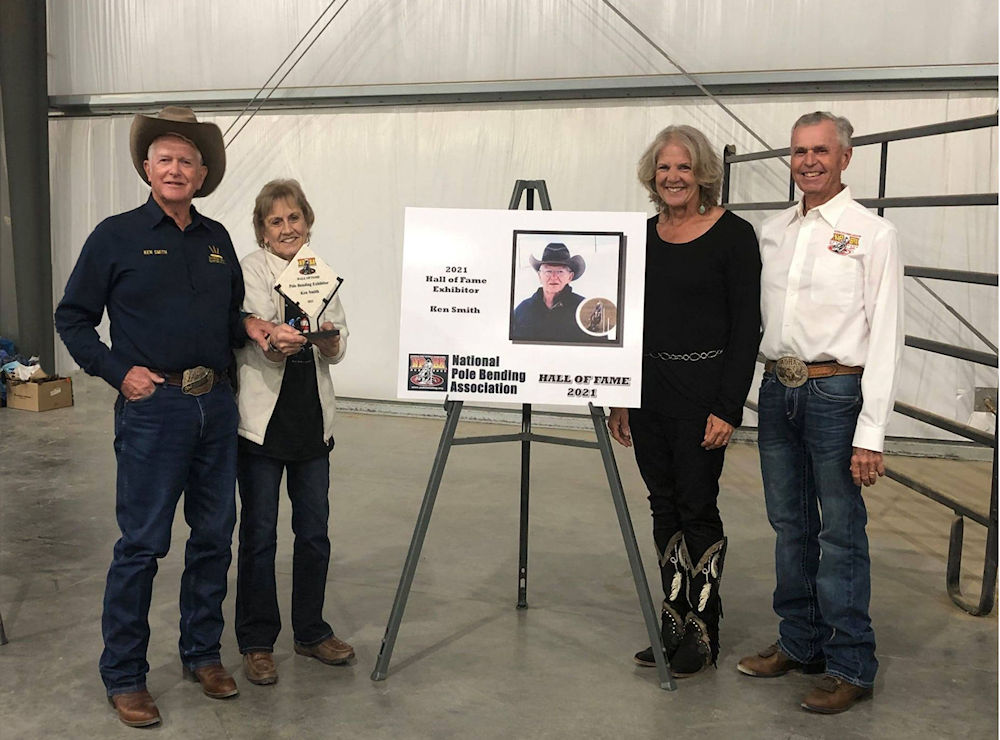
Ken Smith is inducted into the Pole Bending Hall of Fame.
L to R: Ken Smith, Pat Smith, Marsha Hill, Ross Carnahan
( click on the photo to enlarge )
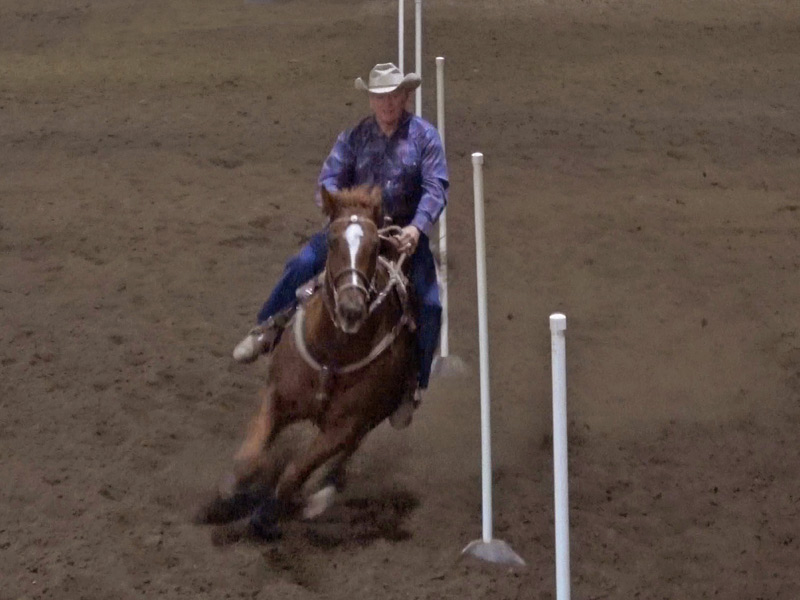
Ken and Tommy, demonstrating correct bending form
( click on the photo to enlarge )
The requirements for success are knowledge, athletic ability, skill, and desire. Realize that they all apply to both the rider and to the horse! Think of pole bending as a partnership; but it is up to the rider, as the leader, to ensure that all the requirements of both horse and rider have been met.
We attempt to address all of these requirements at our clinics. We use a proven teaching format that gets results: Hear it, See it, Do it, and Feel it! Visualization is an important aspect of learning the mechanics of any sport. We start with knowledge. We explain the event in detail, using diagrams and action videos. A rider must understand what they are trying to do, and then the rider must become a trainer and show the horse.
We use a video and presentation format to initially introduce the technique, then drills are employed that specifically target the key aspects of the event.
At the conclusion of the clinic, my goal is that each student will:
Know when it is right and when it is wrong, and
When it is wrong, know what to do to fix it.
Video!
Please note that we have a video available that covers all the same information we teach at our clinics, and includes examples of the drills we use which we feel are an important part in training success for both horse and rider. Included are examples of correct technique and also problem analysis. Several high speed pole bending runs are also included. It is all there, and you can use it as an introduction before attending a clinic, and as a review after. It is available in your choice of formats - as a USB Flash Drive or as a two DVD set. You can order the video here.
The Origin of the Clinics
Ken Smith and Wayne Sandberg
with Twist Kokomos Jet
When my wife Pat and I began breeding, raising and training horses specifically for barrel racing and pole bending, we planned that I would start the colts, and then Pat would be the one to finish them out and take them through the barrel futurity year. We have always been strong believers that poles are good for a barrel horse, but I began looking for ways for our pole work to become more than merely barrel horse preparation. I set out to improve our pole bending technique so that these well bred horses could excel at this event. I searched for information on pole bending and found very little available. There were a couple of videos, but they proved to be quite superficial.
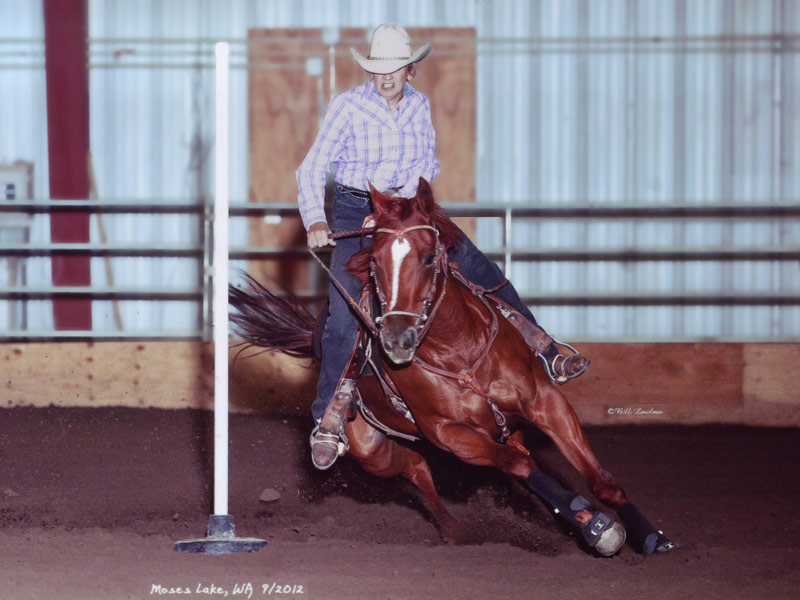
Pat Smith and Sumbunnysperky (Perky)
winning the 2012 1st go of the
WBRA Speed Horse Open Pole Bending,
Moses Lake, WA
( click on the photo to enlarge )
Then I found Wayne Sandberg's book, Nineteen Second Pole Bending, and I was impressed with his detailed analysis of the event. We became friends, and the knowledge I gleaned from his writing and his coaching really helped me on my way. My experience with the successes and failures of competition in those early years helped me to refine my technique and make it my own. I regularly use several of the drills that Wayne originated, while others I've developed on my own, resulting in a set of exercises, drills, and horse handling techniques that work for me, and I have successfully applied them to several horses that have developed into top performers. Over the years I have made many trips to locations all across the country to watch the toughest pole bending competitions and to exchange ideas and ride with many of the best riders and trainers in the game. I continue to compete, and you can see us and our horses in competitions throughout the western US.
The clinics evolved from my personal struggles to master this event. Let's face it: pole bending is a complex event and things happen fast! What is needed is a way to present the details and techniques to students so that they can quickly grasp the main points and be encouraged to work with their horses to perfect their technique. I've found a number of analogies and images that seem to help make it "click" for students. I have had great feedback from the clinics, and we have seen some real success stories from many students.
Click on any photo to view it enlarged. Then use your Browser 'Back' button to return to this page.
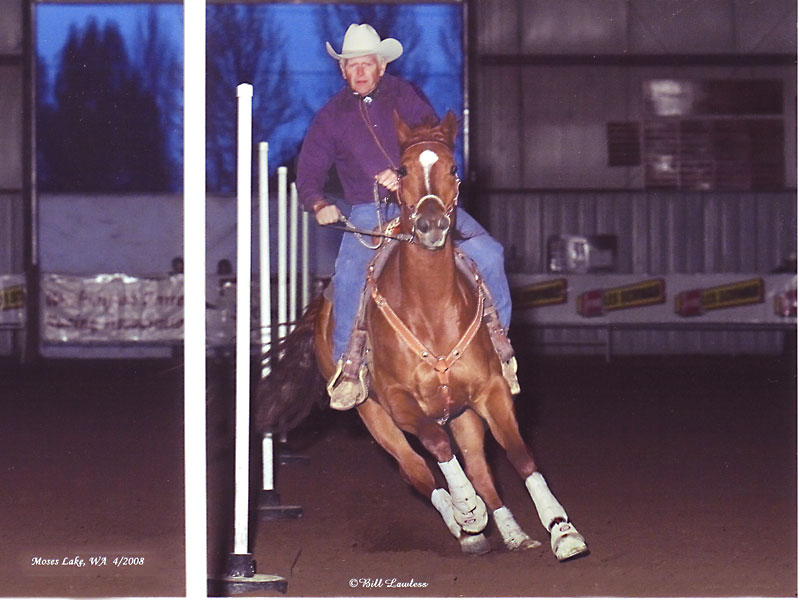
Ken and Sumbunnysperky (Perky) - Moses Lake WA Pole Futurity Champions 2008 (click to enlarge) |
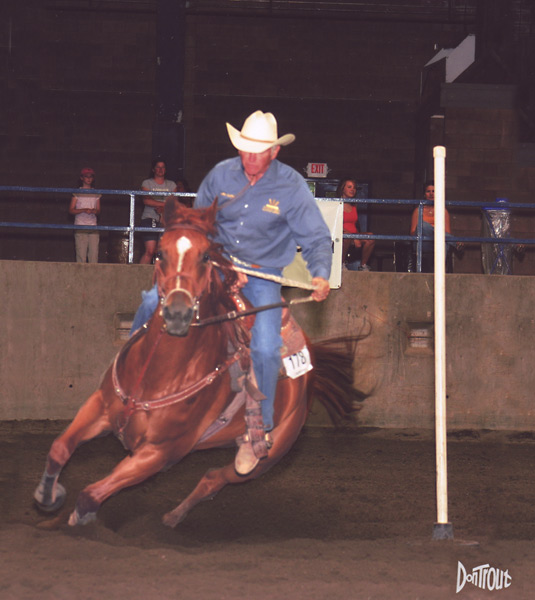
Ken and Perky - Central Point OR |
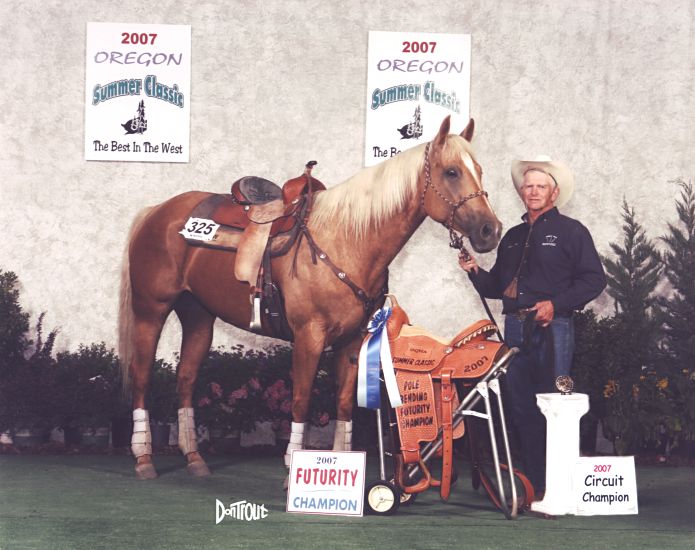
Ken and Fire Water Sandy Bar (Sandy), 2007 Pole Bending Futurity Champions |
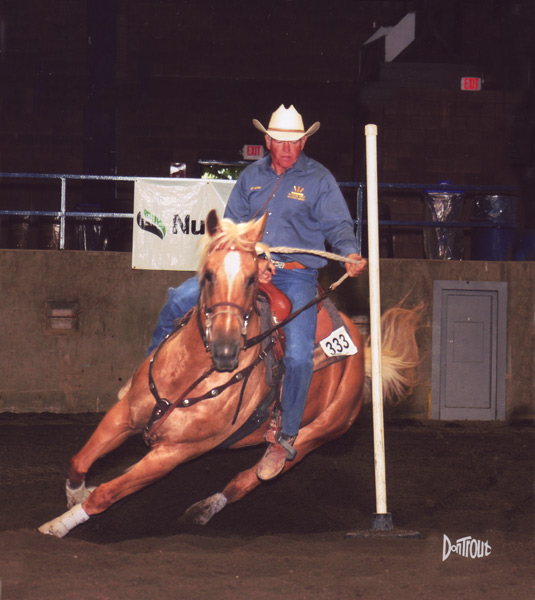
Ken and Fire Water Sandy Bar (Sandy) winning the 2008 Central Point Oregon Circuit Series |
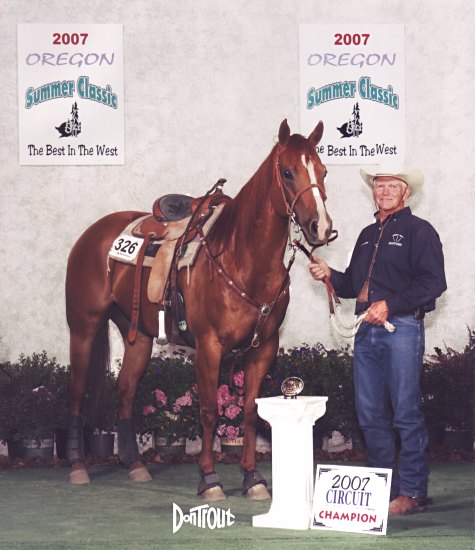
Ken and Sumbunnydunnickbar (Nicky) after winning the 2007 three-run Circuit Series at Central Point, Oregon |
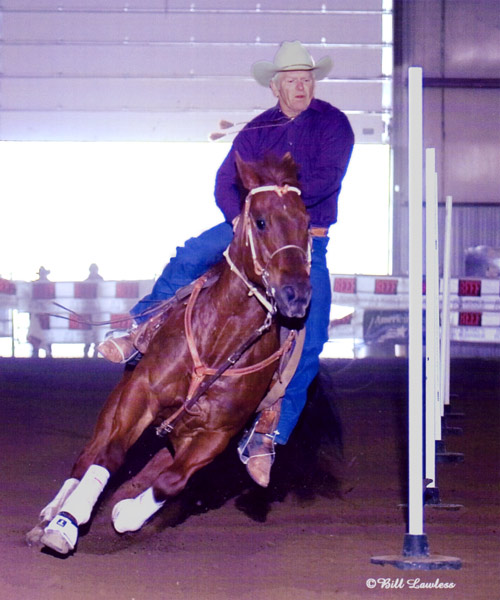
Ashes On The Money (Ashes), WBRA Open Poles Champion 2006 |
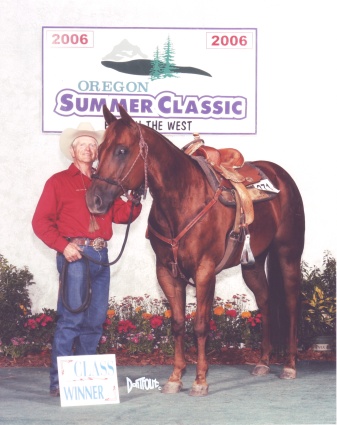
Ashes wins three-run Circuit Series at Central Point, Oregon 2006 |
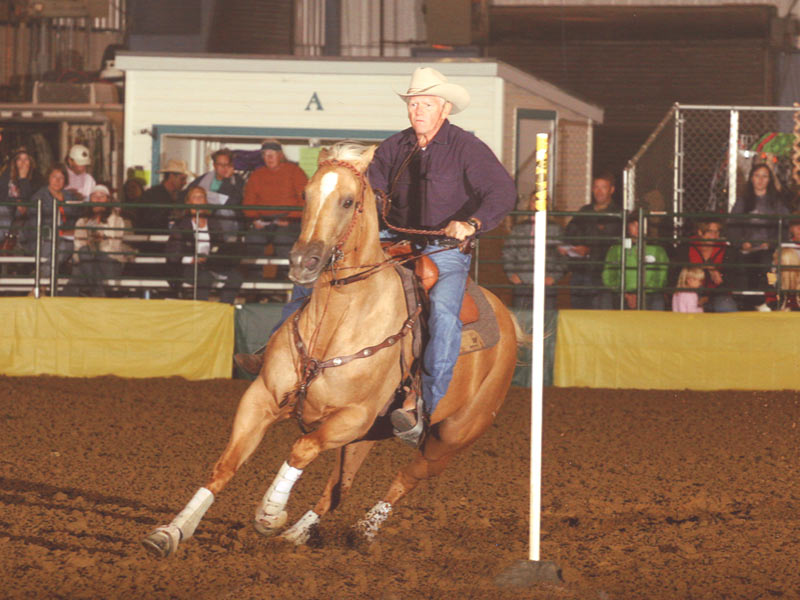
Ken and Sandy placing 2nd in the average at Gillette, WY - 2007 |
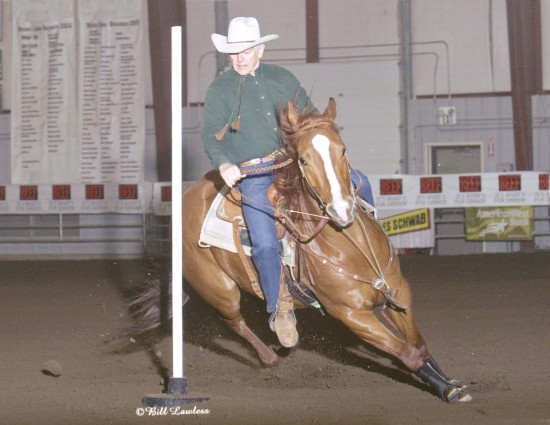
Sumbunnydunnickbar (Nicky), 2006 WBRA Futurity Champion |
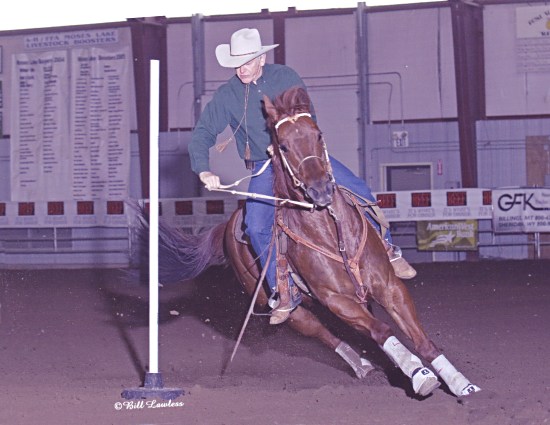
Ashes wins WBRA Futurity 2005 |
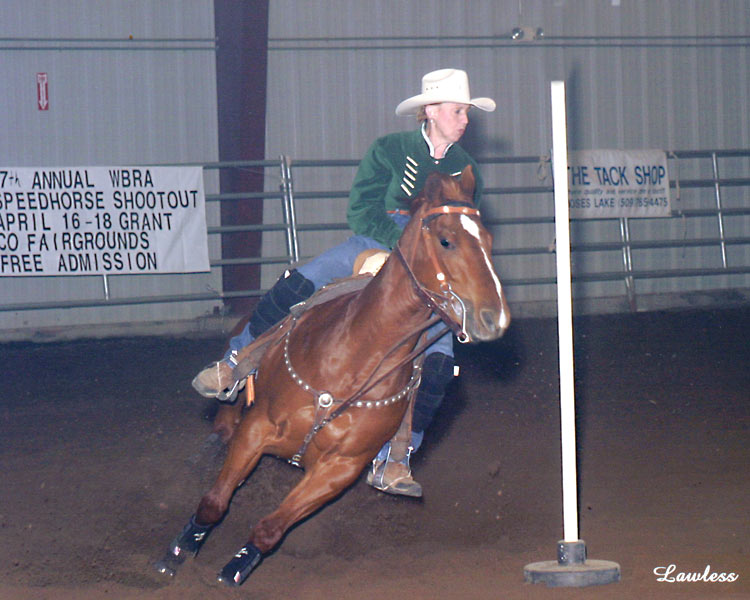
Cowgirl In The Money with Pat Smith, 2004 WBRA Futurity Champions |
Clinic Format
The typical clinic format is two-days, using an early morning start on both Saturday and Sunday. As an option, clinic hosts can elect to have the first lecture and video session on Friday evening, which allows more riding time on Saturday. I like to have between ten (10) and twelve (12) students, and fifteen (15) students is an absolute maximum number. More than that and we get too much waiting. We have had several successful clinics on weekdays! It is one way to avoid conflicts with rodeos and other contests.
We have other options for instruction for smaller numbers, and for returning students who are looking for a refresher. Please contact us for more information on these options.
Clinic Content
Horses don't need to be finished pole horses, but they need to be broke to the point of being able to position them and being able to move them left and right. We begin each phase of the clinic work at a walk or trot, emphasizing position, shape, and technique. I like to go through each phase with each student individually, until they "get it". If they and their horse are ready to lope or gallop, then we will click things up a notch for them. The format has been basically the same:
- Lecture and video
- Basic Speed Event Horsemanship
- Bending
- Building speed
- Turns
- The Run-Down and First Turn
- Putting it all together
The first session is a lecture and video review. I explain the method and the horsemanship behind the method. We watch videos of it being done right, and done wrong. Students are invited to bring their videos for review.
The first thing we do on horseback is to work on some basic horsemenship. I find a majority of students are not aware of their horse's shape and balance as they ride. I want them to learn how to prepare their horse for what is coming next, and to be able to avoid trying to fix a problem after it happens. We will work together on the foundations for speed event horsemanship. We cover flexion, reins, and leg aids, as they relate to speed events. We cover rider positions - position-right, position-left, hand positions, leg positions, body position. We let the rider "feel" the positions and the aids working. Everything else builds on this.
For all of the sessions we ask students to bridle up with whatever bit or hackamore they normally use. We'll watch the horses to see if the head gear is effective.
The bending session starts with anatomy of the bend, the zig-zag slalom pattern, the hips-out, shoulder-out position of the horse, application of position-left, position-right, working with the "crooked" horse - one that flexes on one side but not the other, and the connection between the turns and the bending segments - why a successful bending segment is critically dependent upon the proper completion of the preceding turn.
There is a speed building exercise that is designed to boost the confidence of both horse and rider. The success of this exercise never fails to impress both students and observers.
The session on turns includes the anatomy of a turn, where we teach the basics of the three-pivot turn, preparing the horse for the turn (the most neglected part of successful pole bending turns), rider position for the turn, applying basic horsemanship, properly finishing the turn, the importance of the "look with your body", and avoiding being "behind" the horse. During this session, it is common to be working at a trot into the turns, and then having a horse begin to gallop out. Why? Because it feels good to them! Everything is right and they feel like they can!
We talk about the run-down and the importance of speed. The first turn is similar in many ways to the other turns, but we also point out the critical differences, and we have a drill specifically for the first turn.
For those who want to try a run, we can now put it all together. We don't use a clock. We watch for smoothness and the application of the methods.
Please note that we can provide a certificate of insurance that will satisfy the requirements of your facilities management.
Clinics Schedule:
As of 2025, I do not plan to leave home for any more clinics. I am still giving lessons locally, and local clinics are still possible.
Feedback Comments
Well, I'm going to celebrate a bucket list item for this young lady!
Kiera and Baylee ran poles in rodeo 3 today and ran their fastest time ever with a 19.931!!!!
Thank you Ken Smith and Pat Smith for believing in Kiera and her little red rocket!! We owe it all to the glory of God ~
Kathy M. - North Dakota, 2021
So this just happened in our hometown arena - 19.356. New arena record and personal best for MaRynn. Thanks for all your help with all my girls. We have had so much success with your method. Shannon M - Utah, 2021
Ken,
Kiera started attending your clinics at a very young age. Four years and eight clinics later it brings me such great joy to share with you that she has accomplished her greatest horse related goal in her life so far!!!
This 12 year old recently brought home the 2019 Little Britches Rodeo Association World Champion Junior Pole Bending Saddle and the 2019 LBRA World Champion Junior Average buckle!
She believes that your slow work drills and memorizing your riding style and copying it have allowed her to get with her Baylee mare in a short amount of time.
Your training style, your teaching style, and your patience with young riders speaks volumes Ken!
She would not be where she is now without all that your clinics and videos have taught her!
Kathy M. - North Dakota, 2019
Ken - Hope all is well with you. Just a thanks for the help. Emily won the poles for Wisconsin Junior High. This will be the third trip to Nationals in poles. Keep in touch. KS - Wisconsin, 2018
FB:
Thank you Ken Smith for sharing your amazing knowledge...during an April blizzard.
Very happy with Skylar's and Teenys smooth run and fastest time to date...21.8! ...and the 2nd turn can improve! TE - Minnesota, 2018
FB:
Driving home from a FANTASTIC pole bending clinic! Learned so many amazing things and met a bunch of amazing people.
Ken is a wonderful clinician and gave all of us practical advice, thorough explanations tailored to each horse and rider,
and tons of different pole bending drills to utilize. Can’t wait to see what this year holds for pole bending! EN - Ohio, 2018
FB:
Thanks (to the hosts) for putting it all together. I’ve been to loads of great clinics over the years,
and I can honestly say Ken Smith was the best clinician I’ve studied under! I’d definitely go to another of his. JS - Ohio, 2018
Hi Ken, I thought you would like to hear about our daughter MaRynn. She has been to 2 of your clinics here in Utah. She recently won the Jr. World Champion Little Britches Pole Bending title. In the short round, she had a 19.975. Thanks again for all your help. SM, Utah, 2017
Just wanted to give you Ken a huge thank you! My daughter Taylor came to your clinic in Alberta in Feb 2016. She was about to turn 12 and on a buckskin horse that had never seen poles before. We give credit to you for giving her the foundation of how to ride to your spot. This year at our Provincials she won the average and the Provincial title! This is where we think your foundation helped her - no tipped poles, and placed each time! Taylor said she wants to take your clinic again. She said she can't get enough of your basics and they are such a good refresher! BC, Alberta, 2017
So grateful for having Ken Smith come to Kansas for another one of his pole bending clinics. Don't know what we would do without him.
Awesome participants, great ground and just a lot of wonderful learning occurred. Can't wait to have him back again.
Thank you to everyone that came or helped make it possible.
Ken, Thank you SO much for coming as usual!!! You make my girls' spring every year.
They are so excited for the HS rodeo season to start - thank you SO Much for all you do. KJ, Kansas, 2017
Ken,
Thanks once again for an amazing clinic! Everyone walked away with knowledge and tools for the future.
I'm especially looking forward to building on my horse's foundation to obtain that 19 second run! JA, Minnesota, 2017
Ken,
Still a lot of things to work on, but M. and Gunner ran their first 19.7 together. She was having a problem with the 2nd end right hand turn and would take an extra stride.
You worked with her on that, when to shape her horse for the turn. That must have been the key. We have been watching the video several times already.
Made significant improvements on several of our horses. Thanks for all your wonderful help. SM, Utah, 2016
Ken,
Just wanted to send a note letting you know H. qualified for the Jr. High National Finals Rodeo in the poles. Since coming up earlier to see you again she has broken the 20 second barrier.
Something like 4 of her last 5 runs have been in the twentys. In fact yesterday she ran a 20.5, her fastest time yet.
We can't thank you enough for the help and education you have provided her.
Her knowledge of how to pole bend and how to help her horse is in large part thanks to you. We are really excited about nationals ...
Thanks so much, K.
Hi Ken,
I just wanted to tell you that since we went to your clinic in Bowman, L. has shaved off so much time - she just ran a 21.3 today with so much room for improvement.
I am just amazed at how much improvement there was in that one clinic with this horse!
Thank you, N.
Hi Ken,
Just wanted to shoot you an email and let you know how much I was impressed with the clinic. By Sunday night, my mind was on information overload and I was pole bending until 1:00 AM!
D. (daughter), on the other hand, slept like the dead....she was worn out! I appreciated your patience with me, mom, being in the arena with you and hounding you with questions.
D. and I learned so much this weekend...not just on the pole bending but also horsemanship and the different drills you went through were so helpful.
I cannot wait until the snow melts to get going on my own horse. Again, just wanted to say thanks for all your patience and help. It was an INCREDIBLE clinic.
(you were VERY patient....at some points I would have been pulling my hair out!)
Take care, L.
Hello Ken!
C. and Salty won the National Little Britches Rodeo Association Jr. Girls Poles! They won the World and also the Finals. Coming back to the short go she was high call back, but just barely and the top five were pretty close times.
For the World title she was 10 points ahead of the second place girl. So there was no holding back, she had to have a fast, clean run.
In the short go they took back the top 20. Only one girl hit a pole and there was one high 19. So, not only did it have to be clean she had to be fast!
They ran a 20.002!! It placed 2nd in the round and she won the average for the finals and then with points she won the World. It was exciting to watch and what a thrill!
We have been blessed with good horses and our daughter has a strong passion for animals and competing.
It’s been a fun time! Thank you for all your wonderful instruction and insight that you gave us last year!
Take care, AT, Kansas, 2012
Hi, Ken --
Just wanted to tell you, Ken, that B. ran a 20.9 on Flicka last Saturday and a 20.86 this Saturday. This Saturday she took the last pole with her HAND trying to set it up. She had barely hit it and it looked like it was going to sit up on its own.
She is still so happy that you can't wipe the smile from her face. They are going to do it. She is bound and determined. I am really amazed because even at 20 seconds, there are lots of places where mistakes are made and so I know 19 seconds is coming!!!!!
I am so happy that you came out and the girls got to have a refresher with you! It has helped immensely.
Hey Ken,
This is L. from Montana. I have attended a lot of your clinics and your last one I went to really clicked. I made it to nationals on a race horse I trained with your technique
that had not been trained on poles for even a year. Now that I'm in college, pole bending isn't as important, but I still run him and he clocked his fastest today with a 20.2
(we tipped one) and last weekend we had a clean run of 20.6. I want to thank you because I would not have this kind of horse without your help.
I also started my 4 year old on poles this fall and she has already clocked a 20.2 - it's all because I took what you taught me.
Thanks again!
Hi Ken!
We’ve been in Guthrie, OK all weekend at an event and thought you might want to know how it went. I couldn’t wait to get home and email you about C’s runs!
She worked her horse slow last week keeping him round and using your techniques. She ran a 20.311 and a 20.374!! That is a personal best for them.
The fastest time she’s ever run has been a 20.408 with a hit pole. He ran very honest all weekend. His end poles were still a little deep, but more round and better overall.
We can’t thank you enough for sharing your knowledge with us and taking the time help. We really appreciate it!
Ken,
"I knew I had a good horse for pole bending, but you helped me with the technical movements that really made the difference for winning.
Thank you Ken for all of your help over the years!"
~Jamie Parvin, Silver State Pole Bending Champion
Thank-you Ken,
for all your help in the poles and barrels. D. has really improved and everybody is noticing her now...
We are so happy you came to help. She feels so good about all the things you taught her, and can't wait until she gets a chance to show them off!
SM
We all loved the clinic Ken, you are really a great teacher. You add the why factor and that clears up so much,
I heard this comment all weekend. We loved having you and I really do hope we can bring you out again soon. J's final run last night made it all worth while for her so she is a big big fan.
KA
Ken,
What a wonderful experience for the girls and parents. Thank-you so much.
We are looking forward to spending time with you again.
Sincerely, PM
Dear Ken,
I was reading the feedback about your clinics and thought that I should pass on a little more information. Your clinics and your assistance have
actually led to the 2008, 2009 and 2010 pole bending Champions for the British Columbia High School Rodeo Association. All three of these young ladies have attended
at least one of your clinics and were then able to experience the ultimate success of becoming the Champion. I also have to say
that I have learned a great deal from your clinics and put your ideas to use on every horse I ride. They all learn to run poles and
pick up the technique very quickly. I hope to attend another one of your clinics next year perhaps as I have a couple of young
horses that could use the help.
Thanks again, CL
Dear Ken,
Our daughter attended your clinic at Spearfish, South Dakota. She learned a lot as we did also. She took home what she learned and used it on
her good little quarter pony and had 20 second pole runs consistently all summer long. She was the state champion pole bender for the Jr. High in Nebraska,
and she finished fourth in the world in National Little Britches.
TS
... we have been to the Wrangler Jr. High National Finals. Nationals had 38 States, 5 Canadian Provinces and
Australia represented. The top four kids from each State/Province could come in each event. H. has been working hard to institute your techniques in order to fix her end poles for the last month.
The results were she became the State Champion Pole Bender and she became the Reserve National Pole Bending Champion. We appreciate your in-sights and depth of
knowledge that helped us take Pole Bending to the next level.
God Bless!
Dear Ken, Just wanted to tell you how much we got from attending your clinic in Spearfish. It was awsome. It was better than I imagined it could be. Pole bending is very detailed and I kept wondering how you could 'properly' teach it to the kids. You did a very good job, and your passion for the subject got everyone's attention. As an adult, I learned A LOT from watching the others receive your help. I know I can do better after learning your concepts.
Dear Ken,
We wanted to thank you for working with S. and helping her to achieve her goal of being the British Columbia High School Pole Bending Champion in her Rookie season.
Without a doubt, your coaching was so important to her year long success. The precise way that you analyzed both her and her horse then helped both to make the necessary adjustments
was in my opinion such a huge part of her meeting her goal for the season.
Sincerely, DW
Ken Smith
Sunrise West Quarter Horses, LLC
2240 4th Avenue
Clarkston, Washington 99403
509-780-9614
If you found this information via a search and you have not yet seen our Horsemanship and Pole Bending section, we would like to encourage you to take a look.
All content in this document copyright © Sunrise West Quarter Horses, LLC, all rights reserved.